

Presence Changes What “Playing Together” Means
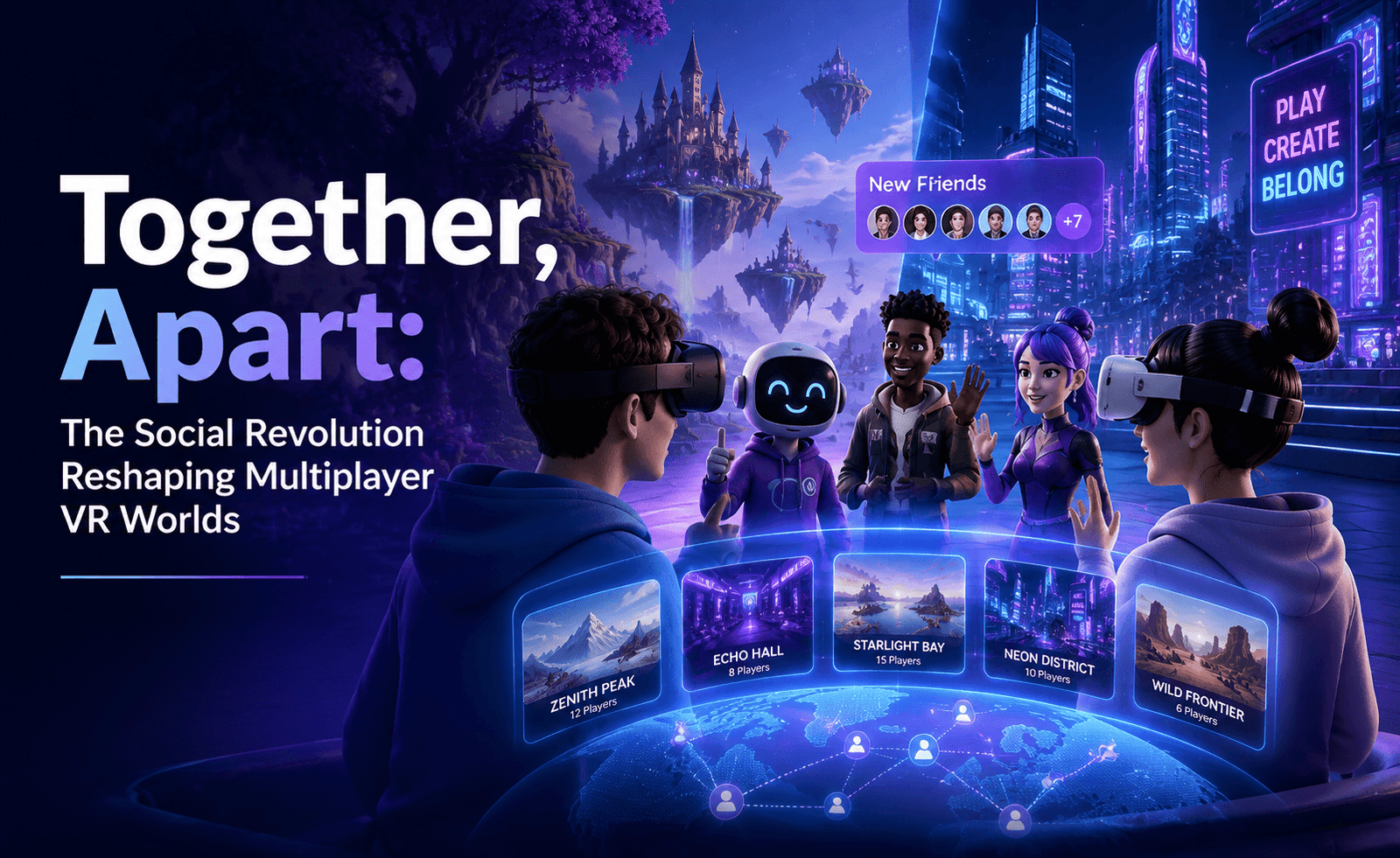
Multiplayer gaming has always meant sharing a space with other people, but for most of gaming’s history, that shared space was mediated through text chat, voice comms, and avatars that gestured at presence without ever really conveying it. VR multiplayer is different in a way that’s easy to state and surprisingly hard to fully appreciate without experiencing it: when another player turns their head toward you, leans in, or reaches out a hand, you register it as an actual social cue, not an animation triggered by a button press. This distinction has quietly reshaped what multiplayer VR games are designed to do, moving many of them away from pure competition and toward something closer to shared physical presence, a distinction that matters enormously for how these spaces function socially.
Micro-Expressions and Body Language Are Doing Real Work
Eye and facial tracking, now standard in premium VR hardware, has enabled avatars that convey genuine micro-expressions: a raised eyebrow during a tense negotiation in a social deduction game, a flinch of surprise when an ally reveals a twist, a subtle look of hesitation before answering a question. These aren’t scripted animations selected from a menu; they’re generated in real time from the actual muscle movement of the player’s face, translated onto an avatar with enough fidelity that other players can read intent and emotion from them almost as naturally as they would from a real face.
Game designers building social and cooperative VR titles have started actively designing around this capability rather than treating it as a nice-to-have cosmetic feature. Social deduction games, where reading other players’ reactions is the entire point of the genre, have found new life in VR specifically because the format finally delivers on a promise the genre always implied but flat-screen versions could never fully honor: that you’re actually watching someone’s face for the truth, not a stylized cartoon avatar going through a fixed set of animations.
Shared Physical Space Creates Genuine Social Norms
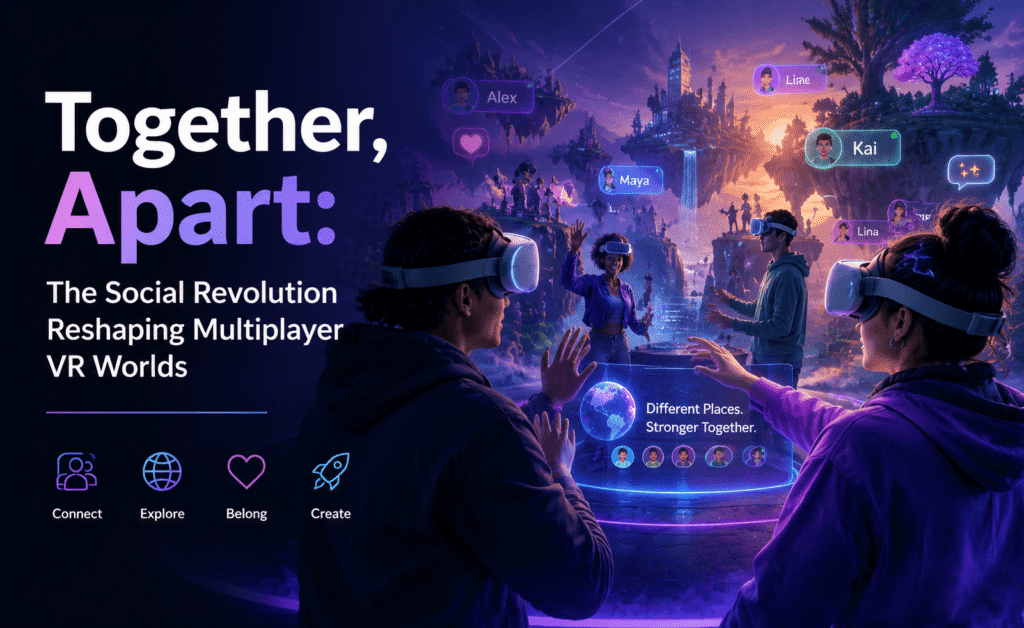
One of the more unexpected developments in multiplayer VR has been the emergence of spontaneous social norms around personal space that closely mirror real-world etiquette. Players in VR social spaces reliably maintain a comfortable interpersonal distance from strangers, similar to what they’d maintain in a physical crowd, without any game mechanic requiring it. Standing too close to another player’s avatar produces a genuine sense of discomfort that most people instinctively avoid, the same way they would in a real elevator or waiting room.
Designers have leaned into this rather than fighting it, building environments and interaction systems that assume players will behave with roughly the same social instincts they carry into physical spaces. Virtual concerts, shared crafting spaces, and cooperative puzzle rooms have all been redesigned around the observation that VR players don’t need to be told to queue politely or give someone space while they’re focused on a task; they largely do it automatically, because the sense of embodiment makes the usual social instincts kick in without prompting.
Cooperative Puzzle Design Has Been Transformed
Cooperative puzzles in flat-screen games have always struggled with a basic communication bottleneck: describing where an object is or what needs to happen typically requires stopping to explain verbally, because there’s no reliable way to simply point and have a teammate understand the reference. VR removes this bottleneck almost entirely. Pointing at something in VR is unambiguous, visible from any angle, and instantly understood, which has allowed puzzle designers to build far more spatially complex cooperative challenges than were previously practical, puzzles that genuinely require two or more players physically coordinating their perspectives on a shared 3D object rather than verbally describing positions to each other.
This has produced a wave of cooperative VR puzzle titles built around asymmetric information, where each player sees a different part of a shared structure and has to communicate spatial detail to teammates who can’t see what they’re seeing. The genre works specifically because gesture and gaze do so much of the communicative heavy lifting that would otherwise require tedious verbal description, something flat-screen cooperative games have never fully solved.
Persistent Worlds Are Changing What “Logging Off” Means
A related shift has been the rise of persistent social VR spaces that don’t reset between sessions the way a traditional multiplayer lobby does. Players in these environments can decorate a shared virtual space, leave objects or messages for friends who log in later, and return to find the world genuinely changed by what other people did while they were away, rather than resetting to a clean default state. Because these changes are visible and physically situated in a space players actually walk through rather than buried in a menu or a stats page, they carry a stronger sense of continuity than similar features in flat-screen social games ever managed to convey.
This persistence has had a subtle but real effect on how players treat these spaces. Communities that have formed around specific persistent VR worlds increasingly describe them less like a game session and more like an actual place they visit, with recurring social rituals, informal rules about behavior that emerged organically rather than being coded into the system, and a sense of ownership over shared spaces that resembles how people relate to a regular physical hangout more than how they relate to a typical game lobby. Designers building these spaces have started explicitly studying community management practices borrowed from real-world shared spaces, rather than only drawing on traditional game design, because the social dynamics at play increasingly resemble the latter more than the former.
The Genuine Downsides of This Much Presence
Increased social presence isn’t an unambiguous good, and the past year has surfaced real problems that come with it. Harassment in VR carries a different psychological weight than harassment in text or voice chat, because an aggressive gesture made by another player’s avatar, invading personal space, mimicking violence, or persistent unwanted proximity, registers with a visceral discomfort that a nasty message in a chat box simply doesn’t produce. Platform operators have responded with increasingly sophisticated personal space bubbles that automatically prevent other avatars from entering a set radius regardless of their actions, along with faster moderation response times specifically for VR social spaces, but the underlying tension between genuine embodied presence and the vulnerability that presence creates hasn’t fully been resolved, and probably won’t be through technical measures alone.
There’s also a real question of accessibility. Facial and eye tracking depend on hardware most budget headsets don’t include, meaning the richest social experiences in VR are currently concentrated on premium devices, creating a social experience gap between players based on what they can afford, layered on top of the existing hardware divide the category has always had to contend with.
What This Means for the Future of Multiplayer Design
The throughline across all of this is that VR multiplayer works best when designers stop treating it as a graphically enhanced version of traditional online multiplayer and start treating it as a genuinely different social medium, one where body language, personal space, and unscripted micro-expression carry real communicative weight that has to be designed around, not just rendered as decoration. The most successful multiplayer VR titles of the past year share a common thread: they build mechanics that specifically require and reward the kind of social presence VR uniquely enables, rather than porting over mechanics designed for a medium where players were never actually looking at each other’s faces in the first place.
That’s a genuinely different design discipline from traditional multiplayer game design, and the studios that have understood this distinction earliest are producing some of the most socially compelling games in the medium, cooperative, competitive, or otherwise. Whether the broader industry fully catches up to this insight, or continues treating VR multiplayer as a visual upgrade to systems designed for a flatter, less embodied kind of presence, will likely determine which studios define the next few years of the category.
For players who have only ever experienced multiplayer gaming through a screen and a headset microphone, the difference is difficult to describe in the abstract and much easier to simply notice the first time it happens: a stranger in a shared VR space glances toward you at the exact moment something surprising happens on screen, and without either of you saying a word, there’s a shared reaction that feels unmistakably like being in the same room with another person. Whatever else changes about the technology underlying VR multiplayer in the coming years, that specific, hard-to-fake sense of mutual awareness is likely to remain the feature that keeps drawing developers back to design around, precisely because nothing else in gaming has managed to reproduce it quite as convincingly. As headset adoption continues to broaden and facial and eye tracking move down from premium devices into more affordable hardware tiers, that sense of shared, unscripted presence seems likely to become less of a novelty confined to enthusiast circles and more of a baseline expectation for what multiplayer gaming, at its best, is actually supposed to feel like.