

The Cracks in a Dominant Model
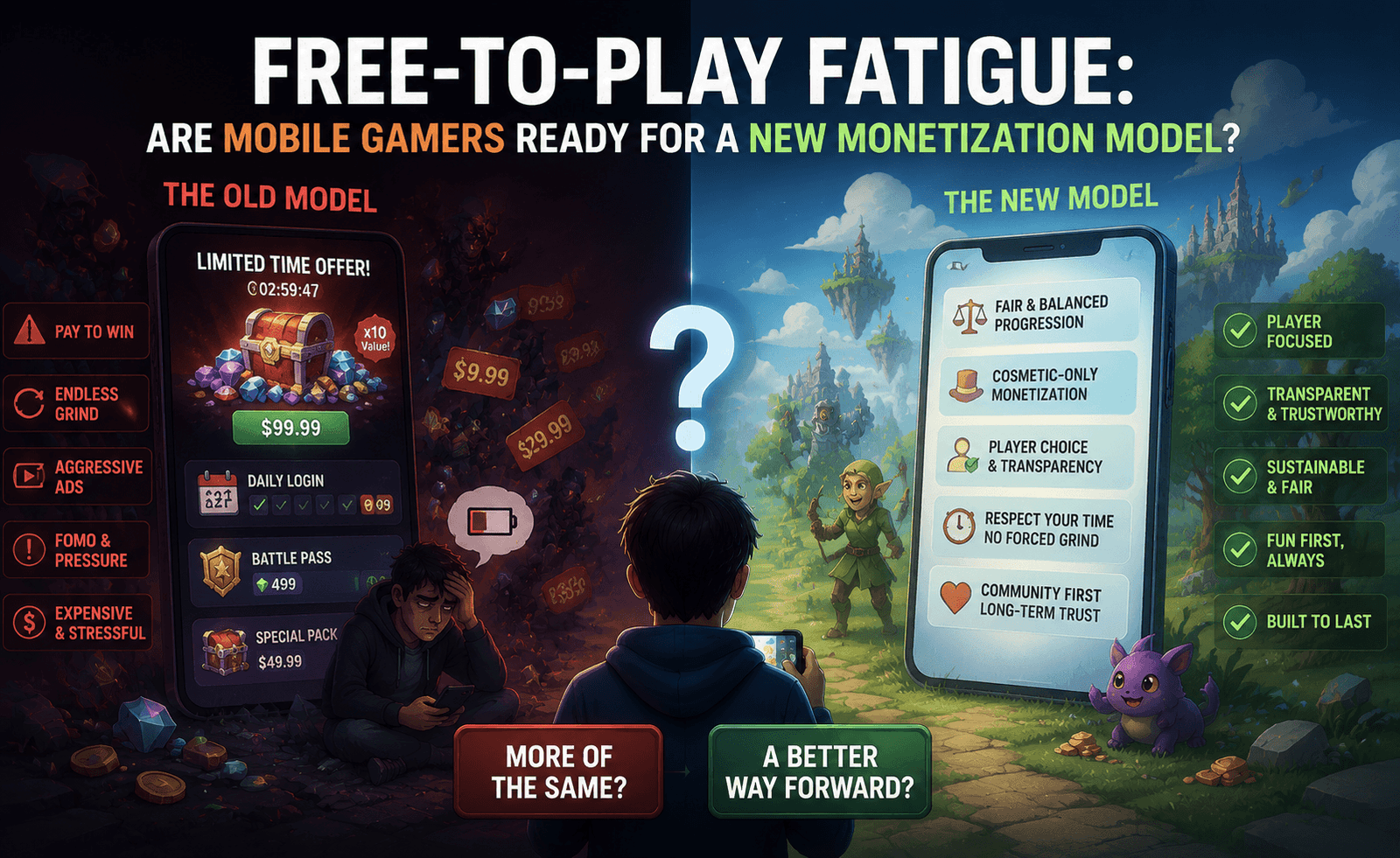
Free-to-play has been the undisputed default business model on mobile for well over a decade, and for good reason: it removes every possible barrier between a curious tap on a storefront listing and an actual install. No price to weigh, no purchase decision to second-guess, just an immediate download and an immediate first impression. That frictionless entry point built some of the largest gaming audiences in history and generated staggering revenue for the studios that mastered its underlying psychology. But a growing chorus of players, critics, and even developers within the industry are now openly questioning whether the model, in its most aggressive current forms, has curdled into something closer to exploitation than entertainment.
The term “free-to-play fatigue” has moved from niche forum complaint to mainstream shorthand for a very real and widely shared player sentiment: exhaustion with energy timers that gate progress behind arbitrary waiting periods, irritation at battle passes that create a constant low-grade sense of obligation, and outright anger at loot box systems whose odds remain opaque even where regulation nominally requires disclosure. None of these mechanics are new, but their cumulative weight, stacked across dozens of games competing for the same limited attention and wallet, has started to produce genuine backlash rather than passive tolerance.
How We Got Here
It is worth understanding why free-to-play mechanics escalated the way they did. Early mobile free-to-play design was relatively restrained, often limited to cosmetic purchases or modest convenience items. But as the market matured and competition for player attention intensified, studios discovered that a small percentage of highly engaged spenders, sometimes called whales, could generate revenue far exceeding what the broader player base contributed collectively. This discovery reshaped monetization strategy across the industry, incentivizing design choices specifically engineered to maximize spending from that small cohort, even when those choices actively degraded the experience for everyone else.
The result was a slow but steady arms race. Energy systems became stingier. Gacha odds became more opaque. Social comparison mechanics, showing a friend’s more powerful character or faster progress, became more explicit and more frequent. Each individual tweak was often small and defensible in isolation, framed internally as a minor optimization, but the cumulative effect over years of iteration produced games that many players now describe, with real frustration, as feeling actively hostile to anyone unwilling to spend significant money.
Signs the Backlash Is More Than Noise
Skeptics of the fatigue narrative sometimes point out that free-to-play games remain enormously profitable, and that vocal criticism on forums and social media does not necessarily translate into meaningful revenue impact. There is truth to this; plenty of aggressively monetized titles continue generating substantial income despite persistent complaints. But several trends suggest the fatigue is having real, measurable effects rather than existing purely as background grumbling.
Premium mobile titles, discussed at length elsewhere, have seen a genuine resurgence, with players actively seeking out and paying for games explicitly marketed around the absence of predatory mechanics. Subscription services bundling curated, respectful mobile games have grown their user bases steadily. And perhaps most tellingly, a growing number of successful free-to-play titles have begun explicitly marketing their monetization as “fair” or “ethical,” a framing that would have been commercially unnecessary if player sentiment on the issue were not shifting in a way studios feel compelled to address directly in their messaging.
What “Fairer” Monetization Actually Looks Like
The emerging alternative models circulating in indie and mobile circles are not a single unified approach but a cluster of related ideas, each attempting to solve the same underlying problem from a slightly different angle. Cosmetic-only monetization, where every purchasable item affects appearance but never gameplay power, has become something close to a gold standard for player trust, since it removes the pay-to-win dynamic that generates the most acute resentment. Fixed-price expansions, selling substantial new content in clearly bounded chunks rather than a continuous drip of small transactions, offer another path, one that borrows more from traditional premium game economics than classic free-to-play design.
Time-limited but generous free trials, giving players a genuinely complete taste of a premium experience before asking for payment, represent a third approach gaining traction, essentially inverting the traditional free-to-play funnel by leading with quality rather than restriction. And subscription models, whether platform-wide bundles or individual game subscriptions, offer yet another alternative, trading the unpredictability of microtransaction revenue for the steadier, more relationship-oriented economics of recurring payment in exchange for an explicit promise of no additional monetization pressure.
The Regulatory Pressure Adding Urgency
Player sentiment is not the only force pushing the industry toward reconsidering aggressive monetization. Regulatory scrutiny of loot boxes and gacha mechanics has intensified across multiple jurisdictions, with some regions requiring explicit odds disclosure and others debating outright restrictions on selling randomized rewards to minors. This regulatory pressure adds a layer of business risk to aggressive monetization strategies that did not exist a decade ago, giving studios an additional, entirely practical incentive to explore alternatives beyond pure player goodwill.
Larger platform holders have also begun adjusting policy in ways that indirectly discourage the most predatory mechanics, from requiring clearer disclosure of purchase odds to giving more prominent storefront placement to titles without aggressive monetization. These platform-level shifts matter enormously because they change the competitive calculus for every developer deciding how to monetize a new release, not just the ones already committed to a particular philosophy.
Not a Complete Rejection, But a Real Diversification
It would be an overstatement to say free-to-play fatigue is killing the free-to-play model outright. The frictionless entry point it offers remains genuinely valuable, particularly for reaching casual and first-time mobile players who will simply never pay up front regardless of a game’s quality. What the fatigue narrative more accurately captures is a diversification of what players will tolerate and reward, a growing segment of the audience actively steering toward models that treat their time and money with more respect, and a competitive landscape where studios ignoring that shift risk ceding ground to those who embrace it.
For indie and mobile developers weighing monetization strategy for an upcoming release, the practical takeaway is less about abandoning free-to-play entirely and more about listening closely to which specific mechanics generate resentment versus which generate genuine enthusiasm. The players are, in aggregate, telling the industry quite clearly what they will and will not continue tolerating. The studios that listen carefully are positioning themselves for a more sustainable, trust-based relationship with their audience, while those that do not may find their goodwill, and eventually their revenue, eroding along with it.
Player-Led Alternatives Gaining Traction
Beyond studio-driven changes, players themselves have begun organizing around the fatigue narrative in ways that shape the market directly. Community-curated lists specifically highlighting mobile games without predatory monetization circulate widely across forums and social platforms, functioning as an informal but increasingly influential alternative to official storefront curation. Review-bombing campaigns targeting titles that introduce particularly egregious monetization changes after launch, sometimes called a “bait and switch” by frustrated communities, have demonstrably pressured some studios into reversing unpopular changes, showing that collective player action can meaningfully affect monetization decisions even after a game has already shipped and established its initial systems.
This organized player response represents a genuine shift in the balance of power between studios and their audience on mobile platforms specifically. Where players once had little recourse beyond simply uninstalling an app that had disappointed them, the combination of public review systems, social media amplification, and organized community advocacy now gives player sentiment a much more direct and immediate channel to influence business decisions, one that studios increasingly cannot afford to ignore even when short-term revenue data might otherwise justify a more aggressive monetization approach.
A More Informed Player Base
Underlying all of these trends is a simple but important cultural shift: mobile players, as a whole, have become dramatically more sophisticated about monetization mechanics than they were even five years ago. Concepts like variable ratio reward schedules, artificial scarcity, and psychological manipulation through social comparison, once discussed mainly in academic or journalistic contexts, have entered mainstream player vocabulary, discussed openly and critically in comment sections and community discussions. This growing literacy makes manipulative monetization tactics measurably less effective than they once were, since players increasingly recognize the mechanics for what they are the moment they encounter them, rather than experiencing them as simply an unexamined, ambient feature of how mobile games happen to work.
Looking Toward a Hybrid Future
The most likely long-term outcome is not a clean victory for either free-to-play or premium philosophies, but a continued blending of the two, with the specific mechanics considered acceptable narrowing over time as player awareness and regulatory attention both increase. Battle passes offering purely cosmetic rewards on a fixed, transparent schedule may well survive this filtering process, since they map onto a subscription-like value exchange that many players find reasonable. Randomized loot mechanics tied to gameplay-affecting power, by contrast, appear increasingly likely to be pushed toward extinction or heavy regulation across major markets, simply because the player and regulatory backlash against that specific category has proven far more sustained and organized than backlash against other, less exploitative monetization tools.
For developers currently planning a mobile release, the practical lesson embedded in all of this is less about picking a single monetization philosophy and sticking to it dogmatically, and more about designing every individual mechanic with an honest, specific question in mind: does this genuinely add value and choice for the player, or does it exist primarily to manufacture artificial frustration that a purchase happens to relieve. That distinction, applied consistently across every system in a game rather than treated as an afterthought bolted on after core design is finished, appears to be the clearest differentiator between mobile titles earning genuine player loyalty in the current climate and those still relying on tactics increasingly recognized, named, and resisted by an audience that has simply grown up.