
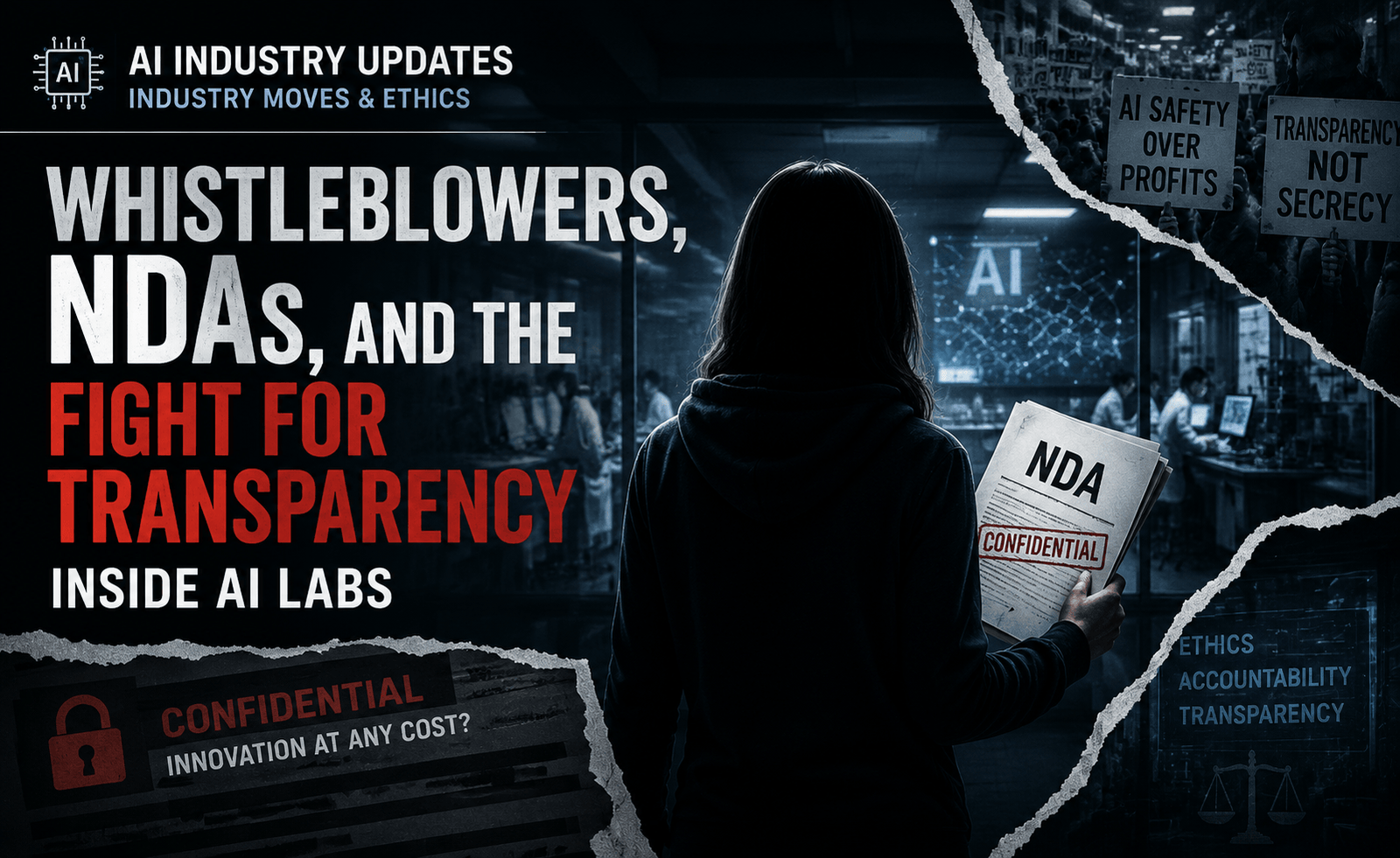
Few issues have done more to shape public perception of AI companies’ internal cultures than the growing number of current and former employees willing to speak publicly about concerns they say were dismissed internally. Over the past several years, departing staff at multiple major labs have described restrictive non-disparagement agreements, aggressive equity clawback provisions tied to silence, and internal cultures where raising safety concerns carried real career risk. These accounts have prompted broader questions about whether AI companies’ public commitments to transparency are matched by how they actually treat employees who want to voice concerns from the inside.
How Non-Disparagement Clauses Became a Flashpoint
Standard practice at many technology companies has long included some form of non-disparagement agreement tied to departure, typically bundled with severance or vested equity. In most industries, these clauses attract little public attention. In AI, they became a significant controversy after former employees at a major lab revealed that their departure agreements included provisions that could result in forfeiture of already-vested equity if they later made critical public statements about the company — without those employees necessarily having been told, in clear terms, what they were agreeing to at the time of signing.
The public reaction to this disclosure was substantial enough that the company in question ultimately stated it would not enforce the relevant clawback provisions and would revise its standard departure agreements going forward. That episode became something of a case study for the industry as a whole, prompting scrutiny of similar provisions at other companies and a broader public conversation about whether tying equity — often a significant portion of an AI researcher’s total compensation — to ongoing silence about a former employer creates an inherent conflict for anyone who might otherwise want to raise a safety concern publicly.
The core tension is not unique to AI: many industries use departure agreements to manage reputational risk and protect legitimate business interests, including trade secrets and confidential client information. What makes the AI context distinct is the scale of financial stakes involved for individual employees, combined with the field’s stated public commitment to safety and transparency as central organizational values. Critics argue that this combination makes restrictive departure terms more consequential than they would be in an industry without that public-facing commitment, since the gap between stated values and internal practice becomes more visible and more damaging when it surfaces.
The Substance of What Whistleblowers Have Actually Raised
It is worth distinguishing between the structural question of departure agreements and the substantive content of what various current and former employees have actually said publicly once they did speak. These disclosures have ranged widely: concerns about compressed testing timelines ahead of high-profile releases, disagreements about whether specific safety evaluations were rigorous enough before a launch, worries about internal cultures that discouraged dissent from senior leadership on release decisions, and, in a smaller number of cases, allegations about specific technical risks that individuals felt were not adequately addressed before a product reached users.
Companies on the receiving end of these disclosures have generally responded in one of two ways: disputing the substance of the specific claims while defending their overall safety processes, or acknowledging that specific concerns had merit while framing the underlying issue as a normal part of iterative product development rather than evidence of systemic negligence. Both responses are plausible in different individual cases, and it would be a mistake to treat every whistleblower account as equally weighted evidence of serious wrongdoing, just as it would be a mistake to dismiss the pattern of these disclosures as simple disgruntlement from departing employees.
What is harder to dismiss is the consistency of certain themes across disclosures from different individuals at different companies: a perceived gap between how much time technical teams wanted for safety testing and how much time they were actually given before a release deadline set by product or executive leadership; a sense among some technical staff that dissenting views on release readiness were heard but rarely changed the ultimate outcome; and a broader concern that competitive pressure between labs was accelerating release timelines faster than internal safety processes could comfortably keep pace with. These are not proof of any specific incident, but the recurrence of similar concerns across multiple organizations, independently, adds a degree of credibility that any single account would lack on its own.
Legal and Regulatory Responses
The public attention generated by these disclosures has begun to translate into concrete policy responses in some jurisdictions. Proposals to establish explicit legal protections for AI industry whistleblowers — comparable to protections that exist in sectors like finance and healthcare — have been introduced in several legislatures, generally aiming to prohibit retaliation against employees who raise safety-relevant concerns through appropriate internal or regulatory channels, and to limit the enforceability of non-disparagement provisions specifically as they apply to safety-related disclosures.
Some AI companies have moved preemptively, establishing internal reporting channels explicitly designed for safety concerns, with stated commitments not to retaliate against employees who use them, and in some cases committing to anonymized or aggregated public reporting on how many concerns were raised through these channels and how they were resolved. These internal mechanisms represent a meaningful step, though they share a structural limitation common to much of AI self-governance: the company itself controls both the reporting mechanism and the disclosure of how that mechanism performs, which limits how much independent verification is possible without external audit or regulatory oversight.
A smaller number of proposals have gone further, suggesting the creation of an independent, cross-industry body — potentially housed within a government regulator or an accredited nonprofit — that AI industry employees could report safety concerns to directly, with some legal protection and a structured process for those concerns to be investigated outside the company’s own internal chain. Such a body does not yet exist in most jurisdictions in a fully operational form, though pilot programs and industry discussions on the concept have advanced further over the past year than in previous years.
Why This Matters Beyond Any Single Company
The whistleblower question sits at an uncomfortable intersection of several issues this article has already touched on: the talent dynamics that determine who has leverage to speak up and who does not, the limits of internal ethics boards whose authority depends on the same leadership whose decisions they are meant to review, and the broader gap between voluntary industry commitments and independently verified accountability. Employees willing to raise concerns from inside an organization are, in many respects, one of the more direct and immediate accountability mechanisms available, since they have visibility into internal decisions that no external researcher, journalist, or regulator can access without their testimony.
If restrictive departure terms, career risk, and financial disincentives make employees reluctant to use that channel, the industry loses one of its more valuable and low-cost sources of accountability — arguably more valuable, in some respects, than external audits or published safety frameworks, since it comes from people with direct, first-hand knowledge of how decisions actually get made rather than how they are described publicly afterward. Whether the current wave of public attention on non-disparagement clauses and whistleblower protections produces durable structural change, or fades as news cycles move on to other AI stories, will likely say a great deal about how seriously the industry’s public commitment to transparency holds up when the transparency in question is uncomfortable rather than convenient.
For now, the pattern across the industry suggests a field still working out, case by case and company by company, what it actually means to be transparent about its own internal disagreements — not just about the technology it builds, but about the sometimes difficult, contested decisions that go into deciding when and how that technology reaches the public.
The Media and Public Attention Cycle
One underappreciated factor shaping how whistleblower accounts land publicly is the unevenness of media and public attention itself. A disclosure that surfaces during a period of heightened public interest in AI safety — often prompted by an unrelated high-profile incident or a major model release — tends to receive substantially more scrutiny, follow-up reporting, and policy attention than a similar disclosure made during a quieter news period. This means the practical consequences a company faces for a given internal failure can depend as much on the broader news cycle at the moment of disclosure as on the underlying severity of the concern being raised.
This unevenness creates a strange incentive structure for both companies and would-be whistleblowers. Companies have some ability to manage timing around their own disclosures and public statements, while individuals raising concerns typically do not have that same control, and often speak up when a concern reaches a personal breaking point rather than at a moment of maximum public receptivity. The result is that some genuinely serious concerns receive comparatively little attention simply because of unfortunate timing, while other, more modest issues become significant news stories because they happen to surface during a period when the public is already primed to scrutinize the industry closely.
Recognizing this dynamic matters for anyone trying to assess the true state of safety culture across the AI industry from the outside. The volume of public attention a given whistleblower account receives is, at best, a loose and unreliable proxy for the actual severity of the underlying issue, shaped as much by timing and news cycle dynamics as by the facts of the case itself. A more reliable long-term signal is likely to come not from any single dramatic disclosure, but from the slower, less visible work of building durable legal protections, independent reporting channels, and industry-wide transparency norms that do not depend on a particular story catching public attention at a particular moment in order to produce accountability.