
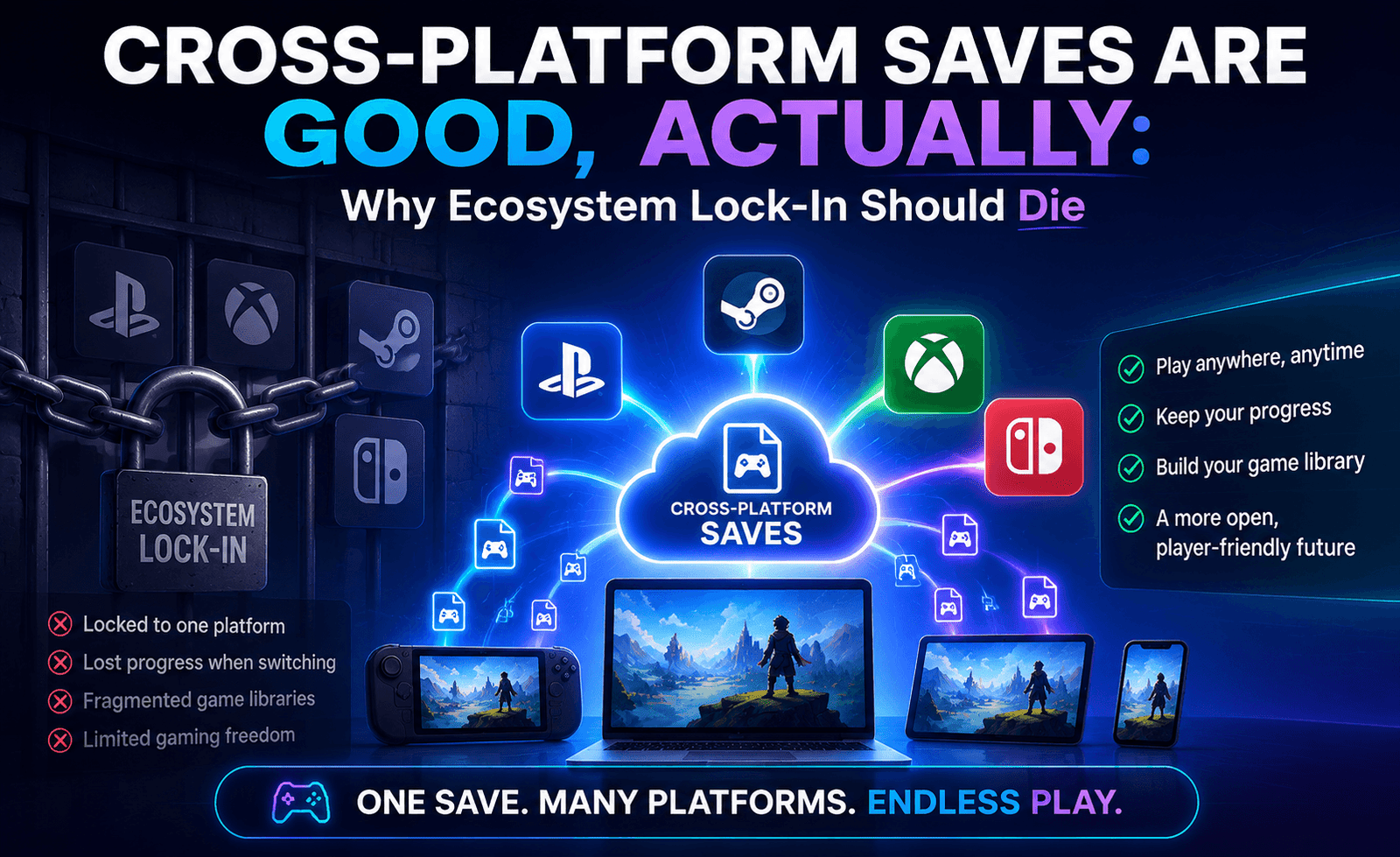
There’s a specific kind of frustration that only makes sense to people who’ve lived through more than one console generation: buying the same game twice, not because you wanted to, but because your progress, your unlocks, and your friends list were all trapped inside a platform you’d since moved away from. For most of gaming history, this wasn’t treated as a flaw in the system, it was simply the system. Your save file belonged to your platform, your platform belonged to a specific ecosystem, and switching ecosystems meant starting over. That arrangement is finally starting to crack, and the fact that it took this long says a great deal about whose interests it was actually serving.
Lock-In Was Never About Technical Necessity
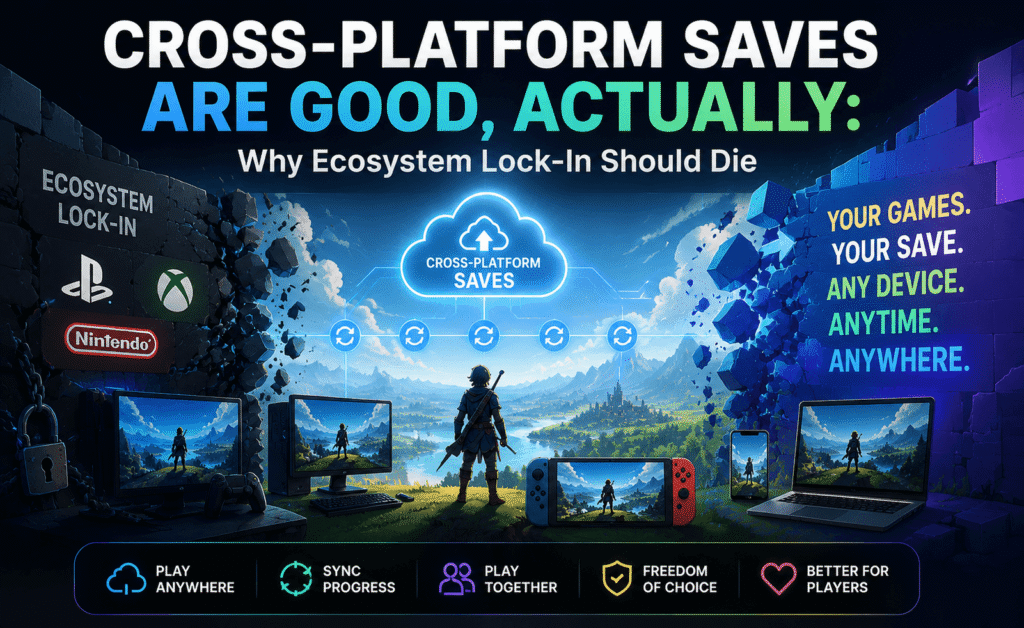
Platform holders have long framed exclusive ecosystems as a natural consequence of differing hardware architectures, and there’s a kernel of truth in that framing when it comes to running the actual executable code across genuinely different systems. But save data, achievement progress, and social graphs are a fundamentally different problem from executable compatibility, and the technical case for keeping those specifically locked to a single ecosystem has always been considerably weaker than platform holders implied.
A save file is, at its core, structured data describing a game state. There’s no fundamental reason that data can’t be stored in a cloud format accessible from multiple platforms, especially once cross-platform play itself became common enough to prove that the same players, on different hardware, could already interact with each other in real time within the same game session. If two players on entirely different consoles can fight the same boss together in real time, the idea that their individual save progress can’t follow them between platforms starts to look less like a technical constraint and more like a business decision dressed up as one.
The Business Logic Behind Keeping Players Trapped
The real incentive behind ecosystem lock-in has always been retention economics. A player with years of save progress, purchased add-ons, and an established friends list on a given platform faces a genuinely steep cost to switching hardware, even if a competing platform offers better performance, a better controller, or a more attractive exclusive lineup. That switching cost isn’t accidental, it’s the entire point. Platform holders have historically benefited far more from making departure painful than from making their own platform actively better than the alternative.
This is precisely why the platforms that have been slowest to embrace full cross-platform save portability tend to be the ones with the most entrenched market position to protect, while smaller or newer entrants into the hardware space have often been the most enthusiastic proponents of cross-platform saves and progression, for the straightforward reason that portability lowers the switching cost in their favor when a player is coming from an established competitor. Portability is only frightening to whoever currently holds the advantage of friction.
What Players Actually Lose Under the Old Model
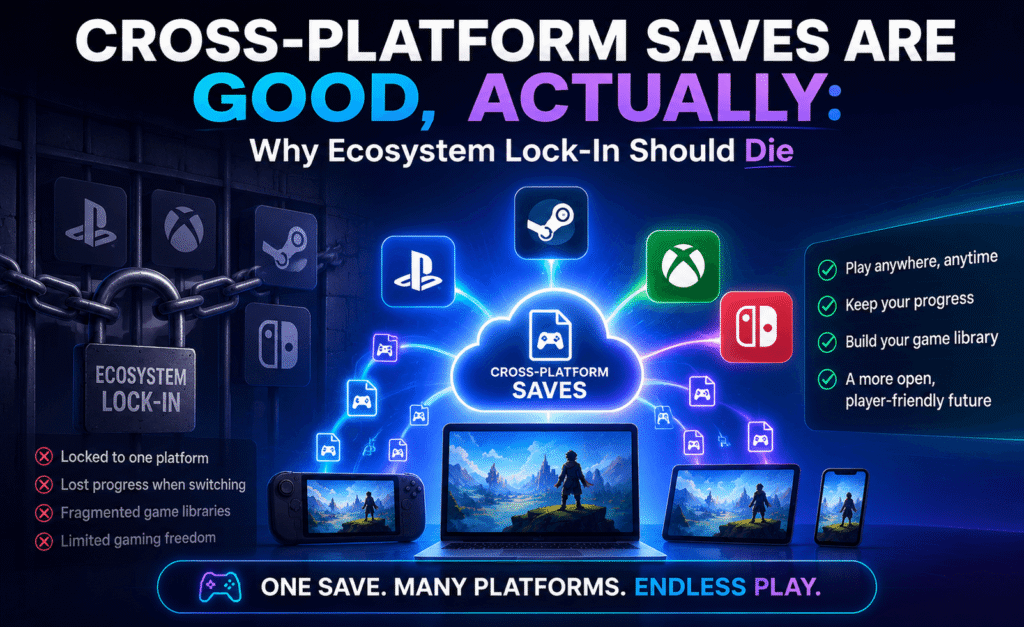
The human cost of ecosystem lock-in is easy to understate because it’s spread out across millions of individually small inconveniences rather than concentrated into one dramatic failure. It’s the player who can’t justify buying a new console because it would mean abandoning a hundred hours of progress in a game they’re still actively enjoying. It’s the friend group that fragments across platforms because switching would mean one member losing access to years of unlocked content, so the group either stays fractured or one person eats the loss to keep everyone together. It’s the household that ends up owning duplicate copies of the same game across two different systems simply because family members ended up on different hardware and neither wanted to lose their individual progress.
None of these situations involve a dramatic villain making an obviously anti-consumer decision in the moment. They’re just the accumulated, quiet cost of a structural choice made years earlier, one that most players never explicitly agreed to but have been living inside for as long as they’ve been gaming.
The Momentum Toward Portability Is Real, But Incomplete
To the industry’s credit, meaningful progress has been made. A number of major titles now support cloud saves that follow a player’s account across platforms rather than a single device, and cross-platform play has gone from a rare novelty to something players increasingly expect as a baseline feature rather than a marketed selling point. But this progress remains inconsistent and often depends more on a specific publisher’s willingness to build the infrastructure than on any industry-wide standard, which means the player experience still varies wildly from game to game and platform to platform.
Achievements and trophies, in particular, remain one of the stickiest holdouts, often staying locked to a specific platform’s ecosystem even when the underlying save data itself has become portable. This matters more than it might initially seem to, since for many players, an achievement or trophy list represents a meaningful record of time invested, and losing access to that record when switching platforms carries a real, if difficult to quantify, emotional cost.
Subscription Services Have Accidentally Proven Portability Works
One of the more revealing developments in this space has come from an unexpected direction: multi-platform subscription libraries. Once a subscription service made the same rotating catalog of games available across console, PC, and handheld devices under a single account, the industry effectively ran a live experiment proving that account-level, cross-hardware access to a shared library was entirely achievable at scale, without the sky falling or exclusive value collapsing in the process. Players under these subscription models have grown accustomed to picking up a game on one device and continuing on another as a baseline expectation rather than a premium feature, which makes the continued absence of that same portability for save data and achievements on traditionally purchased titles look increasingly like a deliberate omission rather than a technical limitation.
This creates an interesting contradiction for platform holders who operate both a walled-off traditional storefront and a portable subscription service simultaneously. The infrastructure and institutional knowledge required to support genuine cross-device account portability clearly already exists somewhere within these companies, since it’s actively powering their subscription offering. The question worth asking is why that same capability so rarely extends to the full-price, individually purchased side of the business, where the switching-cost incentive to withhold portability remains strongest. It suggests that the barrier at this point is almost entirely a business decision about where portability helps versus where it hurts a platform holder’s competitive position, rather than any remaining technical hurdle.
Players who have grown accustomed to subscription-based portability are unlikely to quietly accept a return to platform-locked progress once they’ve experienced the alternative, which means the pressure toward broader portability is likely to keep building from the consumer side even if platform holders remain hesitant to extend it voluntarily. Expectations, once raised, tend to be sticky, and an entire generation of players who never experienced the friction of the old model firsthand may simply treat full portability as a baseline requirement rather than a courtesy, regardless of how reluctant the platforms hosting their favorite games remain.
What a Genuinely Player-First Standard Would Look Like
A truly player-first approach to save portability wouldn’t stop at allowing progress to follow an account across a publisher’s own multi-platform releases. It would extend to allowing players to carry save data, purchased content entitlements, and progress records across any platform that supports a given title, regardless of which platform holder happens to control the storefront on any particular device. That’s a much bigger ask than what currently exists, since it would require platform holders to cooperate on shared standards rather than compete on exclusive convenience, but it’s not technically implausible given how much of the underlying infrastructure already exists in fragmented form.
The strongest argument for pushing toward this standard isn’t abstract idealism about consumer rights, it’s the simple observation that portability tends to reward whichever platform is actually the best experience at any given moment, rather than whichever platform successfully trapped a player years earlier. An industry confident in the quality of its own hardware, exclusives, and services shouldn’t need to rely on switching costs to retain its audience. The fact that so much resistance to full portability still exists suggests that at least some of that confidence may be more fragile than platform holders would like players to believe.
Until that standard arrives industry-wide, the responsibility ends up falling unevenly on players themselves, comparing account systems, researching which titles actually support cross-save before committing to a purchase, and voting with their wallets for publishers willing to build the infrastructure voluntarily. It’s an imperfect stopgap for a problem that a genuine cross-industry standard would solve far more cleanly, but it’s also a reminder that every publisher choosing to support full portability today is making a competitive choice, not just a technical one, and it’s one worth rewarding.
The old model wasn’t broken by accident, it was built deliberately, and it will only be dismantled the same way: deliberately, through sustained pressure from players who stop accepting friction as an inevitable cost of switching hardware. Every generation that grows up expecting portability as a baseline rather than a luxury makes it a little harder for the next platform holder to reintroduce the kind of lock-in that used to be taken for granted without question.