

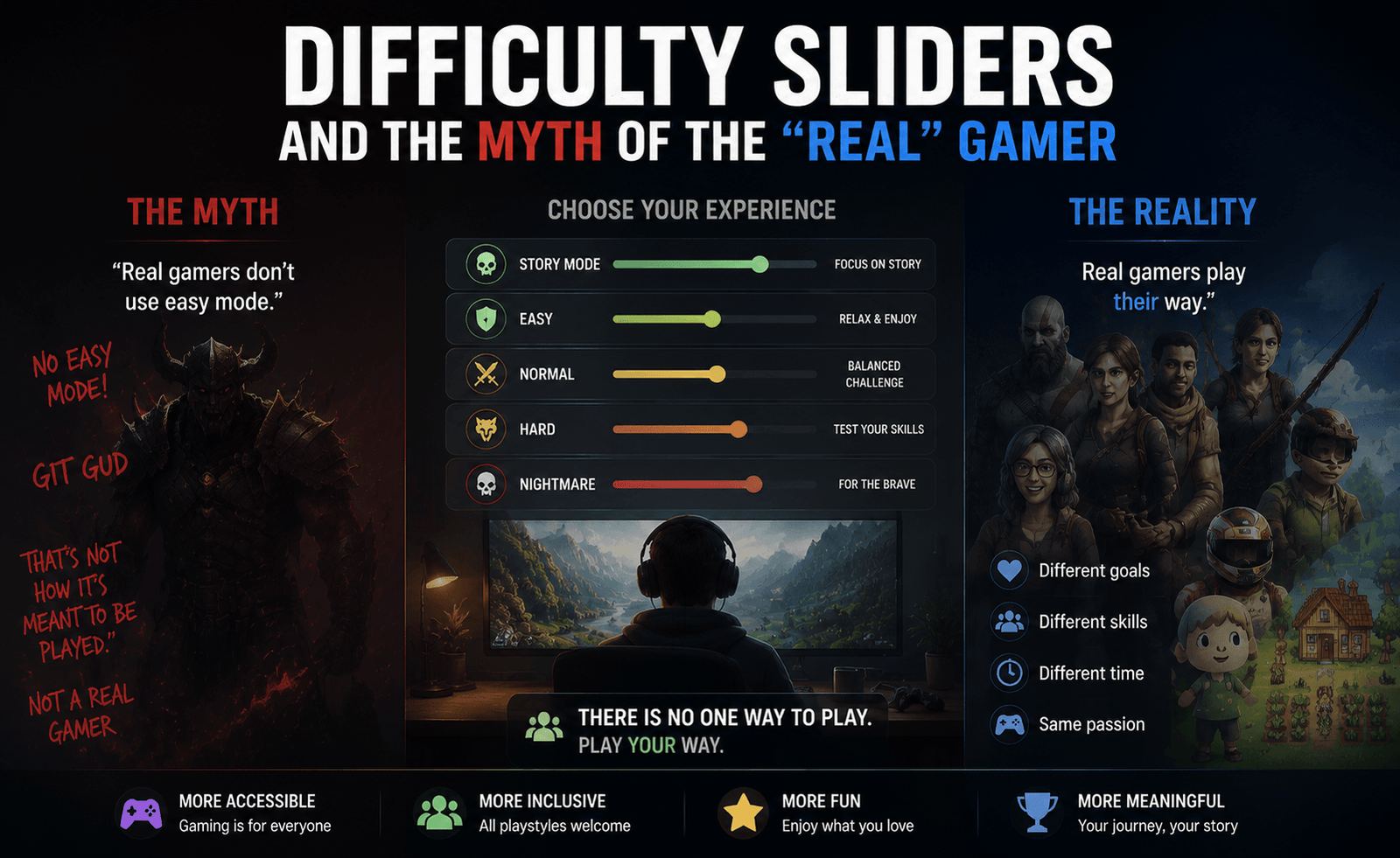
Every few months, a new game arrives with an easy mode, and every few months, the same argument reignites across forums and comment sections: does an accessible difficulty setting somehow cheapen the experience for everyone else? It’s a strange argument on its face, since the presence of an option has never actually forced anyone to use it, but the intensity with which it keeps recurring says something interesting about the identity many players have built around difficulty itself. Underneath the surface-level debate about game design sits a deeper question about what “real” engagement with a game is supposed to look like, and who gets to decide.
Where the Gatekeeping Instinct Comes From
It’s not hard to understand the psychological root of the resistance to easy modes, even when the resistance itself doesn’t hold up to scrutiny. For a certain kind of player, overcoming a brutally difficult game was never just about finishing it, it was about the specific, hard-won sense of accomplishment that difficulty made possible. That accomplishment felt meaningful precisely because it wasn’t guaranteed, because failure was a constant, looming possibility that had to be respected and eventually mastered. When an easy mode appears, some of these players experience it less as an added option and more as a symbolic devaluation of the achievement they worked for, as though the existence of an easier path retroactively cheapens the harder one.\
That reaction is emotionally understandable, but it rests on a flawed premise: that the value of an achievement is determined by whether other people had access to an easier alternative, rather than by the actual effort a given player put in. A marathon runner’s achievement isn’t diminished by the existence of a half-marathon option for other participants. The difficulty a player personally chose to engage with doesn’t retroactively become less difficult because someone else, somewhere, played the same game differently.
Difficulty Was Never a Single, Objective Thing
Part of what makes this debate so persistent is a shared assumption that a game’s “default” difficulty represents some kind of neutral, correct baseline, when in reality every difficulty setting, including the default one, is an arbitrary design decision made by a small team of people trying to balance a specific vision of pacing, tension, and accessibility. There’s nothing inherently more legitimate about the numbers a design team landed on for standard difficulty compared to the numbers they landed on for easy or hard modes. All of them represent choices, not objective truths about how the game is “meant” to be experienced.
This becomes even clearer once you consider how wildly difficulty perception varies based on factors that have nothing to do with dedication or skill in any moral sense: reaction time changes with age, available free time affects how much a player can practice a difficult encounter, physical disabilities can make certain input demands genuinely inaccessible regardless of effort, and simple unfamiliarity with a genre’s conventions can make an experienced player in one genre feel like a total novice in another. A difficulty slider doesn’t erase skill differences, it acknowledges that skill isn’t the only variable determining whether someone can complete and enjoy a game.
Accessibility Options Are Not the Same as Making a Game “Easy”
One of the more useful reframes in this conversation is separating “difficulty options” from “accessibility options,” even though they often get lumped together in public debate. A colorblind mode isn’t making a game easier in any meaningful sense, it’s removing a barrier that has nothing to do with the intended challenge and everything to do with a design assumption that happened to exclude a subset of players. The same is true for adjustable text size, remappable controls for players with limited mobility, and options to reduce or eliminate rapid quick-time-event sequences for players with certain motor or processing differences.
Difficulty sliders that adjust enemy damage or player health sit in a slightly different category, since they do directly touch the intended challenge curve, but even there, the argument that an option “ruins” the experience doesn’t hold up, because nobody who prefers the standard or hard setting is required to touch the slider. The entire premise of the backlash rests on the idea that someone else’s private, personal choice about how to configure their own single-player experience somehow reaches across the internet and diminishes a completely separate person’s completed playthrough. It doesn’t, and it can’t, because difficulty achievements are personal by definition.
The Business Case Publishers Rarely Say Out Loud
There’s also a commercial reality quietly driving the expansion of difficulty options that rarely gets acknowledged directly in these debates: a game that only a narrow slice of highly skilled, highly available players can finish is a game that a much larger slice of paying customers will abandon partway through, generate frustrated reviews about, and be less likely to recommend to friends who don’t share the same skill level or free time. Difficulty options aren’t purely an act of ideological inclusivity, they’re also a practical mechanism for maximizing the number of people who can have a satisfying, completed experience with a product they already paid for.
Framed that way, the resistance to difficulty options starts to look less like a principled stand for artistic integrity and more like an objection to a business allowing more of its paying customers to actually finish and enjoy what they bought. Very few other forms of entertainment ask their audience to prove a minimum skill threshold before being allowed to experience the ending, and it’s worth questioning why games are so often treated as an exception.
The Speedrunning Community Already Solved This Problem
Ironically, one of the gaming subcultures most closely associated with extreme difficulty and mastery has already worked out a healthier relationship with configurable challenge than the general discourse around easy modes usually acknowledges. Speedrunning communities routinely organize their leaderboards into distinct categories precisely because they understand that comparing achievements across genuinely different rule sets is meaningless, and that this doesn’t diminish any individual category’s legitimacy. A glitchless run, a hundred-percent completion run, and an any-percent run using every available exploit are all tracked, celebrated, and respected as separate accomplishments rather than treated as competing claims to a single “real” way to finish the game.
That framework offers a useful model for the broader difficulty debate. Nobody in the speedrunning world seriously argues that a glitchless category’s existence cheapens the any-percent category, because the categories were never in competition to begin with, they’re simply different, clearly labeled challenges that different players opt into based on what they find interesting. Difficulty sliders function the same way when you strip away the identity anxiety that surrounds them: a hard-mode completion and an easy-mode completion aren’t competing claims on the same achievement, they’re separate categories that happen to share a menu screen, and treating them as a threat to one another says more about a need for external validation than about any actual dilution of accomplishment.
It’s also worth noting that speedrunning leaderboards are entirely optional, self-selected, and publicly visible by choice, which is precisely the kind of transparent, opt-in structure that makes external validation possible for those who want it without requiring anyone else’s setting to change. A player who wants their difficulty achievement recognized by peers already has avenues to seek that recognition explicitly, through community leaderboards, screenshots, or simply telling friends. What that player doesn’t have any legitimate claim to is insisting that an option irrelevant to their own save file be removed from someone else’s menu entirely.
What Genuine Design Integrity Actually Looks Like
None of this means every difficulty implementation is executed thoughtfully. There’s a legitimate design conversation to be had about difficulty settings that accidentally strip out mechanics central to a game’s identity rather than simply adjusting numeric variables, since that kind of implementation can genuinely change what the experience is rather than just how hard it is to access. Thoughtful difficulty design preserves the core mechanical identity of a game across every setting, adjusting the margin for error rather than removing the systems that make the game what it is.
The best examples of this in recent years share a common approach: they treat difficulty as a dial on player-facing variables like damage, resource scarcity, or enemy aggression, while keeping the underlying systems, combat mechanics, and puzzle logic fully intact regardless of setting. That distinction, rather than the mere presence or absence of an easy mode, is the actual measure of whether a difficulty option respects the integrity of the design. The myth of the “real” gamer earning the “real” experience was never really about protecting design integrity in the first place. It was about a specific group’s sense of identity being tied to exclusivity, and exclusivity, unlike genuine craftsmanship, doesn’t require anyone else to be locked out in order to remain meaningful.
The healthiest possible future for this debate is one where difficulty settings are discussed the same way graphics settings already are: a set of configuration choices a player makes for their own personal experience, worth reviewing and comparing, but not worth treating as a referendum on anyone’s character. A game’s difficulty slider says nothing about the player who adjusts it beyond the simple fact that they wanted to play the game a certain way, and that, on its own, has never been anything to gatekeep.