

An Unlikely Scale of Ambition
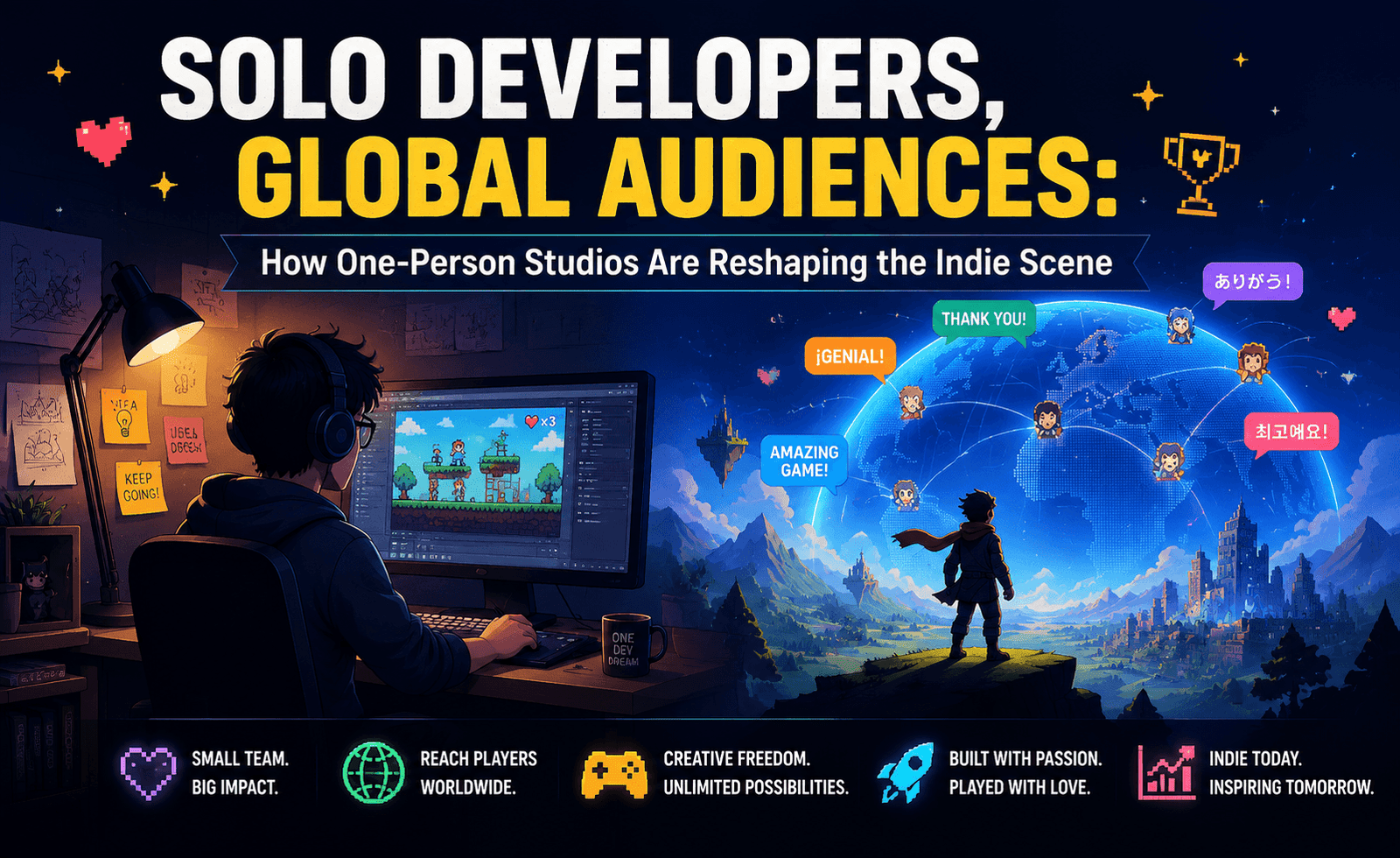
There is something almost absurd about the modern solo developer’s position: a single person, working from a bedroom or a rented desk, occasionally competing directly for player attention and storefront placement against studios employing hundreds of people and marketing budgets measured in the millions. And yet, with increasing regularity, that single person wins meaningful chunks of that attention, sometimes even outright dominates a category, armed with nothing but a laptop, a clear creative vision, and an enormous amount of accumulated skill across disciplines that used to require entire departments.
This is not a new phenomenon in the abstract; solo and small-team development has existed since the earliest days of the games industry. But the scale at which it is now happening, and the sophistication of what a single motivated person can realistically ship, has changed dramatically. What was once a hobbyist curiosity has become a legitimate and increasingly common career path, one that mobile and indie storefronts actively cater to, and one that is quietly reshaping expectations about what a “professional” game even needs to be.
The Tools That Made This Possible
None of this would be feasible without the maturation of accessible development tools over the past decade. General-purpose game engines that once required significant technical expertise to operate now offer visual scripting systems, extensive asset marketplaces, and enormous community knowledge bases that dramatically flatten the learning curve for a single person tackling programming, art, audio, and design simultaneously. What once required a specialist team can now, for a sufficiently determined individual, be assembled through a combination of self-taught skill, purchased or licensed assets, and an ever-growing ecosystem of tutorials created by other solo developers who came before.
Mobile platforms in particular have benefited from this democratization. The technical overhead of shipping to a phone, handling different screen sizes, managing storefront submission processes, integrating basic analytics, has been steadily reduced by improved tooling and documentation, lowering the barrier for a solo developer to go from a working prototype to a published, discoverable product without needing to hire specialists for each of those steps.
Distribution Without a Marketing Department
Perhaps the most consequential shift has been in how solo developers reach players without traditional marketing infrastructure. Social media platforms built around short-form video have proven unexpectedly effective distribution channels for indie developers willing to document their own process, share development milestones, or simply post satisfying gameplay clips that spread organically. A single viral clip showing an interesting mechanic or a striking visual moment can generate more meaningful attention for a solo-developed mobile game than a modest paid advertising campaign, and it costs nothing but time and a willingness to be visible online.
This has produced an interesting cultural shift within the solo developer community itself, where building a public audience around the development process has become almost as important a skill as the development work itself. Developers who once worked in near-total isolation now routinely share progress updates, respond to community feedback in real time, and build anticipation for a launch months or years before it happens, effectively running their own marketing department through sustained, authentic engagement rather than paid promotion.
The Emotional and Practical Cost of Going It Alone
None of this should obscure the genuine difficulty of solo development, which remains an extraordinarily demanding path both practically and psychologically. A single person juggling programming, art, sound, writing, marketing, community management, and business operations simultaneously faces a workload that would be split across an entire department at a larger studio, and burnout is a persistent, well-documented risk within the community. Many successful solo developers speak candidly about multi-year projects that stretched far beyond their original timeline, financial precarity during long development periods without income, and the isolating experience of working without colleagues to share the daily grind of production.
The successful solo projects that do reach an audience often represent significant survivorship bias; for every widely celebrated one-person success story, there are countless abandoned projects, burned-out developers, and games that never found their audience despite genuine craft and effort. This reality is worth acknowledging honestly, both to respect the difficulty of what successful solo developers have accomplished and to avoid romanticizing a path that carries real financial and psychological risk for anyone attempting it.
Why Global Audiences Respond So Strongly
Part of what makes solo-developed games resonate with players is precisely the transparency of their origin. In an industry increasingly associated, fairly or not, with corporate monetization strategy and impersonal live-service design, a game clearly made by one identifiable person, with a distinct creative voice and visible personal stakes in its success, carries an authenticity that resonates strongly with players fatigued by more anonymous, committee-designed alternatives. Players often describe feeling a personal connection to solo-developed titles that is difficult to replicate with larger productions, a sense of directly supporting an individual’s creative vision rather than contributing revenue to an impersonal corporate entity.
This authenticity also tends to manifest mechanically and thematically. Solo-developed games are frequently more willing to take unusual creative risks, pursue niche subject matter, or commit fully to an idiosyncratic vision that a committee-designed product, filtered through multiple layers of stakeholder approval, might have softened or abandoned entirely. That willingness to be genuinely strange, personal, or specific is a significant part of why solo development continues producing some of the most memorable and distinctive titles in the broader mobile and indie landscape, disproportionate to the tiny fraction of overall industry resources those developers actually command.
A Sustainable Model, Not Just a Lucky Exception
While individual breakout successes attract the most attention, a quieter and arguably more important trend is the growing number of solo developers building sustainable, if modest, long-term careers rather than chasing a single viral hit. These developers often release smaller, tightly scoped projects more frequently, build a loyal following across multiple titles rather than depending entirely on one breakthrough, and treat their back catalog and their audience relationship as a long-term asset rather than a one-time lottery ticket.
This more measured, sustainable version of solo development receives less press attention than the occasional headline-grabbing runaway success, but it likely represents a healthier and more replicable model for the broader community. It offers a genuine glimpse of what a diversified, resilient indie ecosystem can look like: not a handful of lucky outliers, but a growing population of individual creators steadily building careers, one modestly successful, personally meaningful release at a time, each one contributing to an increasingly rich and varied mobile and indie gaming landscape shaped as much by individual voices as by any studio’s institutional strategy.
The Mentorship Layer Within the Community
One of the least visible but most important factors sustaining the solo developer boom is the extensive, largely informal mentorship network that has grown up around it. Established solo developers routinely share detailed postmortems, breaking down what worked, what failed, and what they would do differently, giving newer developers a level of practical, specific guidance that would have been almost impossible to access a generation ago outside of a formal studio apprenticeship. Online communities dedicated specifically to solo and small-team development function as a kind of distributed support structure, offering technical troubleshooting, emotional encouragement during difficult stretches of a project, and honest feedback on early prototypes from people who understand the specific pressures of working entirely alone.
This mentorship culture has measurably accelerated the learning curve for new solo developers entering the space, compressing what might once have taken years of trial and error into a more efficient, guided process informed by the accumulated experience of everyone who came before. It has also fostered a genuine sense of collective identity among solo developers, many of whom describe their relationship with this broader community as one of the most valuable and sustaining aspects of an otherwise frequently isolating career path.
What Larger Studios Are Learning From Solo Developers
Interestingly, the influence has begun flowing in both directions. Larger studios, watching solo developers consistently produce distinctive, critically acclaimed work with a fraction of typical development resources, have started adopting some of the same practices: smaller internal teams given genuine creative autonomy, more direct and transparent communication with players during development, and a renewed willingness to pursue smaller, more personal projects alongside larger flagship titles. Some studios have gone further, explicitly funding or publishing solo developers’ work, recognizing that the authenticity and creative risk-taking associated with individual vision is genuinely difficult to replicate through traditional committee-driven development, however well-resourced that committee might be.
This growing mutual respect between solo developers and larger studios suggests the two are increasingly understood not as competitors fighting over the same limited attention, but as complementary parts of a healthier, more varied mobile and indie ecosystem, one where a player might reasonably spend one evening with a meticulously polished, massively resourced flagship release and the next with a deeply personal, idiosyncratic game built entirely by one person working out of a spare bedroom, and find both experiences equally worth their time.
Financial Realities Behind the Success Stories
It is worth being candid about the financial mechanics that actually sustain a solo development career, since public narratives often skip past the unglamorous middle stretch between an initial idea and a commercially successful release. Many solo developers rely on savings, part-time or freelance work on the side, or a supportive partner’s income during the often multi-year gap between starting a project and seeing meaningful revenue from it. Crowdfunding and early access releases have become popular tools specifically because they allow a solo developer to generate some income and validate demand well before a project is finished, reducing the financial risk of committing years of unpaid labor to an idea that might ultimately fail to find an audience.
Publishers specializing specifically in indie and solo-developed titles have also emerged as an increasingly important part of this financial ecosystem, offering upfront funding, marketing support, and platform relationships in exchange for a share of eventual revenue, effectively allowing a solo developer to retain creative control over the actual game while offloading some of the business operations that would otherwise consume time better spent on development itself. This publisher relationship, when structured fairly, has become one of the more reliable paths for a talented solo developer to bridge the gap between a promising prototype and a fully realized, professionally marketed release without needing to become an expert in business development along the way.