

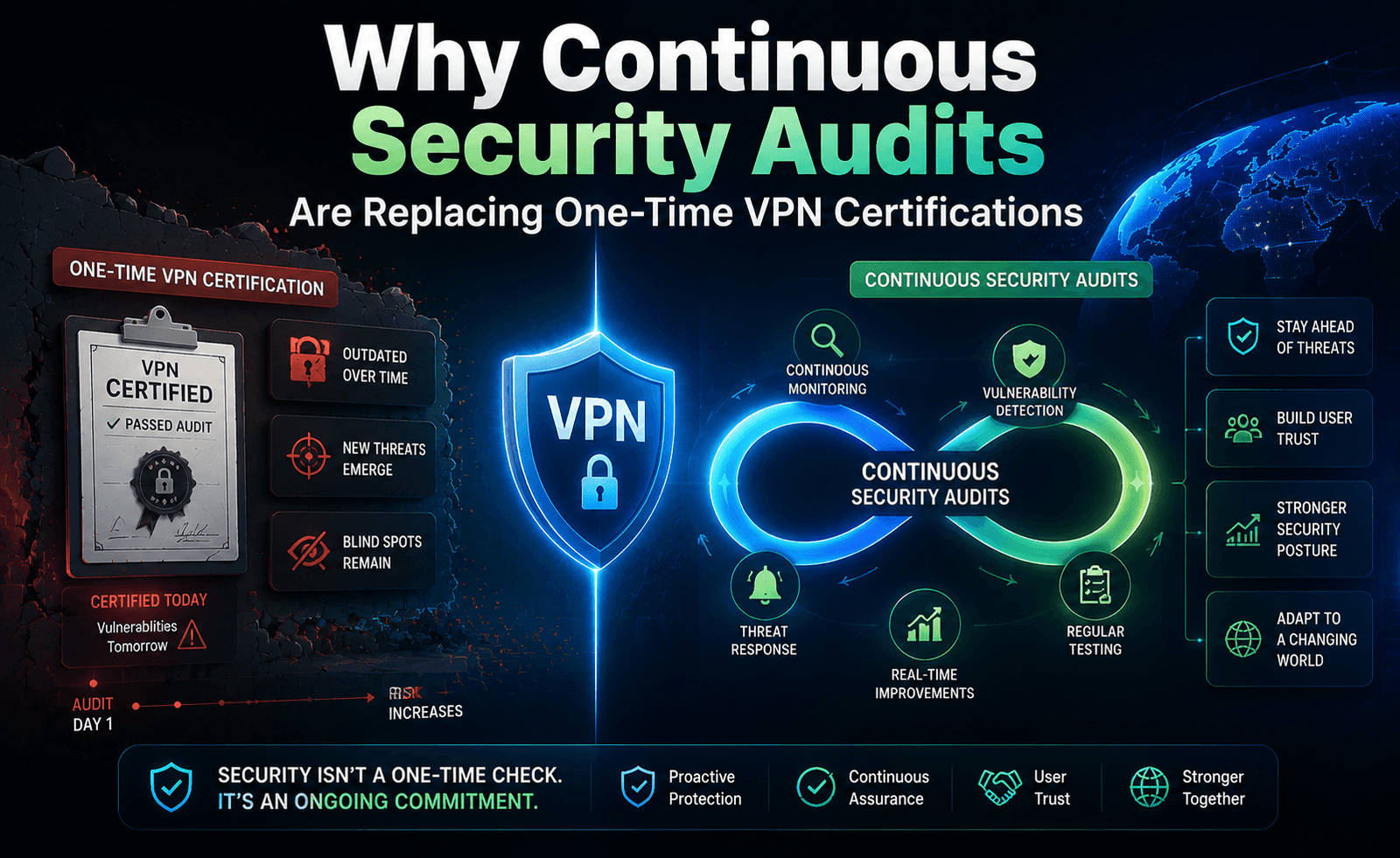
For years, the standard playbook for a VPN provider looking to build trust was simple: commission one comprehensive security audit, publish a press release, and reference that single engagement in marketing material for as long as the report remained findable. That model is increasingly viewed as insufficient — not because those original audits were dishonest, but because software is not static, and a report describing infrastructure from two product versions ago tells a shrinking user base less and less about the system they’re actually using today. This report examines why continuous auditing models are gaining traction, what they look like in practice, and how to tell a provider that’s genuinely embraced this shift from one that’s just added a new slide to the same old pitch.
The Core Problem With Point-in-Time Audits
A traditional audit is, by design, a snapshot. It reflects a specific codebase, a specific server configuration, and a specific set of internal processes, all frozen at the moment testing concluded. VPN providers, like any software company, ship updates constantly — new features, infrastructure migrations, changes in cloud hosting arrangements, new third-party integrations, and personnel changes in the engineering team that originally implemented the audited privacy protections.
Any of these changes can silently invalidate the conclusions of a prior audit without the provider necessarily realizing it. A server migration to a new hosting provider, for instance, could introduce logging at the infrastructure level that the original audit never anticipated, simply because the new provider’s default configuration differs from the one that was tested. Nobody needs to act in bad faith for an eighteen-month-old audit to no longer accurately describe the current system.
What “Continuous Auditing” Actually Looks Like
Rather than a single large engagement, a continuous auditing approach typically combines several smaller, more frequent mechanisms:
Recurring Scheduled Audits
Instead of a single audit referenced indefinitely, providers commit to a fixed cadence — commonly annual or semi-annual — with either the same firm or a rotating set of auditors. Rotating firms has a specific advantage: different auditors bring different methodologies and areas of focus, reducing the risk that a single firm’s blind spots go unnoticed engagement after engagement.
Bug Bounty Programs
A structured bug bounty program invites independent security researchers to continuously probe production systems in exchange for financial rewards for verified findings. Unlike a scheduled audit, a bug bounty program operates year-round, providing an ongoing stream of scrutiny rather than a concentrated burst every twelve months. Programs with a public leaderboard and a track record of paid-out rewards for real findings tend to be a stronger signal than a bug bounty page that exists but shows little activity.
Transparency Reports
Separate from security audits, regularly published transparency reports disclose statistics on government data requests received, how many were complied with, and under what legal basis. When combined with technical audits, transparency reports add an operational, legal-facing layer of continuous disclosure that a one-time infrastructure audit cannot provide on its own.
Automated Continuous Monitoring
Some providers now integrate automated configuration-monitoring tools that continuously verify server configurations against an approved baseline, alerting engineering teams if a server drifts from the expected no-logging configuration — effectively extending the spirit of a manual audit into an always-on technical control rather than a periodic check.
Why This Shift Is Happening Now
Several forces are pushing the industry toward continuous models. Increased regulatory scrutiny in multiple jurisdictions has raised the bar for what counts as credible evidence of privacy practice. Growing user sophistication — helped along by outlets that actually read and compare audit reports rather than repeating press releases verbatim — means a stale audit is less effective at reassuring an increasingly skeptical audience. And competitive pressure plays a role too: once a handful of prominent providers adopted recurring audit cadences and public bug bounty programs, the relative credibility of a competitor still relying on a years-old single audit declined by comparison, creating pressure across the industry to keep up.
A single audit report answers the question “was this system secure on this date.” A continuous auditing program answers the more useful question: “how does this company respond when something goes wrong?”
How to Tell Genuine Commitment From a Marketing Refresh
Not every provider that talks about “ongoing security commitment” has actually restructured its practices around continuous verification. A few concrete signals separate the two:
- Published audit history — a visible timeline of multiple audits over multiple years, ideally from more than one firm, rather than a single report re-promoted repeatedly.
- Active bug bounty payouts — public evidence that the bounty program has actually resulted in paid rewards for real findings, not just a dormant policy page.
- Regularly updated transparency reports — published on a fixed schedule (usually semi-annual or annual) rather than a one-off document from several years back.
- Version-specific audit scope — recent reports that explicitly reference current app and infrastructure versions, rather than reports that predate several major releases.
What This Means for Evaluating a Provider Today
When comparing VPN providers on security grounds, the presence of an audit is no longer a sufficient differentiator on its own — most established providers have at least one audit report somewhere in their history. The more meaningful differentiator has shifted to cadence, breadth, and the existence of continuous mechanisms alongside periodic formal audits. A provider with a single audit from three years ago paired with silence since is in a materially different position than one publishing recurring audits, running an active bounty program, and issuing regular transparency reports, even if both technically qualify as “independently audited.”
The Cost and Resource Reality Behind Continuous Auditing
It’s worth acknowledging plainly that continuous auditing is expensive, and this has real implications for how the practice is likely to spread across the industry. A single comprehensive audit engagement from a reputable firm can run into the tens of thousands of dollars depending on scope, and a genuinely continuous program — recurring formal audits, an actively monitored bug bounty program with real payouts, and regularly staffed transparency reporting — represents a recurring operational cost that smaller providers may struggle to sustain at the same cadence as larger, well-capitalized competitors.
This creates a legitimate tension worth naming: continuous auditing practices are becoming an emerging expectation among security-conscious users, but they are also becoming a competitive advantage that larger providers can afford more easily than smaller ones, regardless of the actual underlying quality of either provider’s engineering. Readers evaluating a smaller or newer provider shouldn’t necessarily penalize it for lacking the same audit cadence as an industry giant, but should instead look for proportionate signals — a single recent, well-scoped audit and a functioning, even if smaller, bug bounty program can represent a genuine commitment to verification even without the full continuous-auditing apparatus of a larger competitor.
What Users Can Actually Do to Encourage This Shift
Individual choices do shape this market over time. Prioritizing providers that publish recurring audits and active bug bounty results over those relying on older, one-time reports sends a demand signal that providers and their marketing teams do track. Asking direct questions through customer support channels about audit cadence, requesting links to full technical reports rather than accepting a marketing summary, and treating a stale audit reference as a point of concern rather than a reassurance are all small but cumulative pressures that push the broader market toward more rigorous, ongoing verification practices rather than a single certificate earned once and displayed indefinitely.
Reading a provider’s own security or trust page with this in mind changes what to look for. Instead of searching for a single reassuring sentence about “independent verification,” look for a dated history: when was the most recent audit, how many have there been, is there an active and funded bug bounty program with a visible history of payouts, and is there a transparency report published on a predictable schedule. A page that answers all four of those questions with specific dates and figures is describing an operating program. A page that answers with a single unlinked sentence is describing a marketing claim.
None of this means a single well-scoped audit is worthless, or that every provider needs a fully staffed continuous-verification program to be worth trusting. It simply means that the presence of an audit alone has stopped being a strong differentiator on its own, and the more meaningful signal today lives in the pattern of ongoing activity around it.
Our Takeaway
The shift from one-time certification to continuous security verification reflects a maturing understanding, across both providers and users, that software security and privacy practice are ongoing processes rather than states that can be certified once and left unattended. For readers evaluating VPN providers, the right question is no longer simply “have they been audited,” but “how recently, how often, and through how many independent mechanisms are they still being checked.” That distinction is becoming the real dividing line between providers that treat privacy as a genuine operating discipline and those that treat it as a one-time marketing milestone.